REVIEW · GRAND CANYON NATIONAL PARK
25-min Grand Canyon South Rim EcoStar Helicopter Tour with Optional Hummer
Book on Viator →Operated by Papillon Helicopters · Bookable on Viator
In about 25 minutes you get a true view from the sky, flying over the Grand Canyon’s widest and deepest stretch, plus the North and South Rims and the Dragon Corridor. I love how the ride feels smooth and professional, and I love the in-flight narration that helps you connect what you’re seeing to what it actually is. The main thing to consider is that weather can affect flight schedules, and if you’re booking for a tight day, you’ll want some flexibility.
If you choose the optional open-air Hummer, the experience shifts from aerial wow-factor to a slower, close-up look at the rim area with a guided drive. This is built for small groups, with a max of 15 travelers, which usually means less chaos and more time to get oriented before you fly. Just don’t ignore the practical stuff: check-in is early, and weight limits can affect your seat.
In This Review
- Key Points That Matter Before You Go
- 25-Minute EcoStar Helicopter: What Your Sky Time Really Looks Like
- The Aerial Route: Widest/Deepest, North Rim, South Rim, and Dragon Corridor
- Stop-by-Stop Breakdown: What Each Phase Is Doing for You
- 1) Widest and deepest stretch: the scale shock
- 2) North and South rim forest scenery: context, not just beauty
- 3) Dragon Corridor and additional rim views: the Grand Canyon as a route
- Optional Hummer Combo: When Ground Time Makes the Aerial Tour Better
- Price and Value: Why $339 Can Feel Worth It
- What the Small-Group Size Changes (Maximum 15 Travelers)
- Check-In, Timing, and the 30-Minute Rule
- ID and Seat Rules: Weight Limits and Window Expectations
- Weather: The Part You Can’t Control
- Meeting Point: Papillon Helicopters in Grand Canyon Village
- Should You Book This Tour? A Practical Recommendation
- FAQ
- How long is the helicopter portion?
- Is the Hummer tour included?
- Where does the tour start?
- Do I need an ID?
- What time should I arrive?
- Is there a weight limit?
- How many people are in the group?
- Are entrance fees included for non-U.S. residents?
- Does the tour run in all weather?
- Can I cancel and still get a full refund?
Key Points That Matter Before You Go
- A 25-minute flight that actually covers the highlights: widest/deepest area, plus North and South Rims and the Dragon Corridor.
- Small-group feel: maximum 15 travelers, so it’s easier to move and settle.
- Narration keeps the views meaningful: in-flight narration is available in multiple languages (English is included; German has been noted).
- Optional 2-hour open-air Hummer adds depth: you trade sky time for guided ground time.
- Weight rules can change your seat: 300 lbs is the cutoff; 300+ may require buying an additional seat on the day of the tour.
25-Minute EcoStar Helicopter: What Your Sky Time Really Looks Like
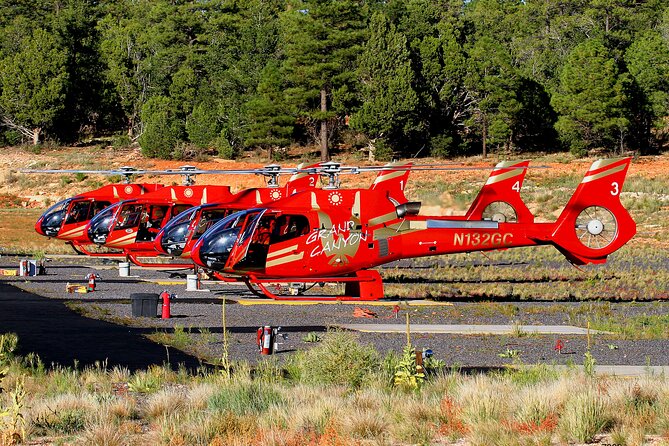
This is a straightforward, time-efficient tour: you’re planning around a short window, and then the aircraft takes you where big sights tend to be hardest to experience any other way. Expect a smooth flight that’s timed to show you the canyon from above rather than just skim the edges.
The “EcoStar” name signals a modern approach to comfort and visibility. Many people book this because they’ve walked the rim before and still felt like they didn’t fully understand scale until they saw the canyon from overhead. If that’s you, you’ll appreciate how quickly it delivers the size lesson.
Also, the narration matters more than you might think. When you’re staring down at twisting layers of rock and river cuts, a running explanation helps you “read” the view instead of just admire it.
You can also read our reviews of more tours and experiences in Grand Canyon National Park.
The Aerial Route: Widest/Deepest, North Rim, South Rim, and Dragon Corridor
The flight isn’t random sightseeing. It’s built around a couple of big “wow” targets and a few supporting scenes that make the Grand Canyon feel less like a postcard and more like a system.
You’ll fly over the widest and deepest part of the Grand Canyon, which is the moment that usually hits hardest. From the air, distance compresses and expands at the same time: ridges look close, then suddenly you see how far drop-offs truly go.
From there, you’ll see the vast forest scenery along the rim areas bordering both the North and South Rims. This adds context—because the canyon isn’t just rock. The surrounding vegetation helps you judge temperature, elevation changes, and how the region breathes as a whole.
Then you’ll fly the Dragon Corridor area and more rim scenery on the way. Even if you don’t memorize every named section ahead of time, seeing those named routes from above helps you understand why geologists and park interpreters get excited about this corridor.
Stop-by-Stop Breakdown: What Each Phase Is Doing for You
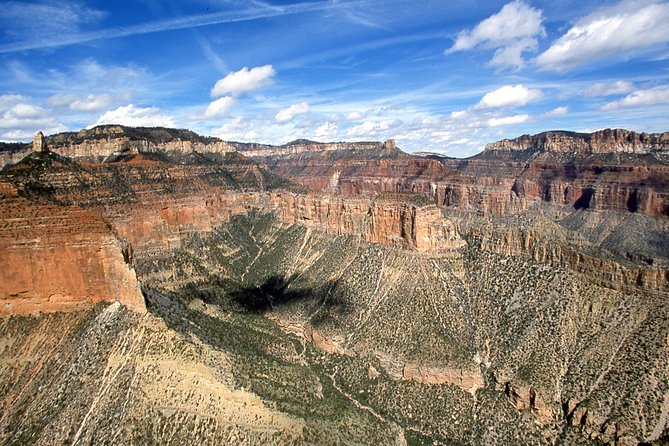
1) Widest and deepest stretch: the scale shock
This part is the core reason many people pay for helicopter time. It’s not just dramatic. It’s educational, because the canyon’s width and depth become obvious in a way that rim viewpoints can’t always deliver.
The helicopter vantage also reduces the “guessing” you’d do from ground trails. You don’t have to map the canyon in your head. You can see how the layers and river carve the space.
2) North and South rim forest scenery: context, not just beauty
After the scale shock, the forest scenery provides context you can feel. You’ll better understand what the canyon borders—how the rim relates to surrounding terrain and why some areas look greener or more sheltered than others.
This is where the narration earns its keep. Without it, you might treat the forest like a pretty backdrop. With it, you start noticing elevation differences and how the rim environment frames the canyon.
3) Dragon Corridor and additional rim views: the Grand Canyon as a route
This segment helps you see the canyon not as a single spot but as a connected landscape. From the air, corridors and rim segments feel like paths—something you can follow visually.
If you’re the type who likes travel photography, this is also where you’ll get the “I can finally capture it” feeling. The aerial angle often produces clearer compositions than what you can get standing at one fixed viewpoint.
Optional Hummer Combo: When Ground Time Makes the Aerial Tour Better
The optional upgrade pairs your flight with a 2-hour guided open-air Hummer tour. That changes the day’s pace. The helicopter gives you the map. The Hummer gives you the terrain around the map.
If you only do the helicopter, you’ll leave with unforgettable views and a strong sense of scale. If you add the Hummer, you get a chance to connect those aerial images to where the roads, viewpoints, and rim edges actually sit.
This combo is a good fit if you want more than “one highlight.” It’s also a good choice if you’re traveling with people who might get nervous in small aircraft but still want the adventure element. Since the open-air tour is separate, you can experience both types of perspective in one packaged plan.
One caution: if you’re not a fan of waiting for a weather-dependent schedule, combining two activities can make timing feel tighter. Build slack, especially if you’re landing from another city or have a later dinner reservation you care about.
Price and Value: Why $339 Can Feel Worth It
At $339 per person, this isn’t a budget add-on. You’re paying for three things: time (a short flight window), access (a view you can’t replicate from the rim), and professionalism (modern aircraft operations and narrated interpretation).
Here’s how I’d think about value. If you already plan to hike and spend hours at rim viewpoints, a helicopter can still be worth it—but only if you want a second perspective that changes your understanding, not just more scenery.
For many first-time Grand Canyon visitors, the helicopter is the fastest way to grasp the canyon’s scale. For repeat visitors, it can feel like a “truth serum,” because the view forces a new mental model even if you’ve memorized overlooks on the ground.
If you’re the sort who likes more time overhead, you might feel the short duration and wish it lasted longer. That’s not a problem with the tour itself—it’s just the nature of a compact flight. If you know you want maximum air time, consider upgrading to a longer flight option when available (or pair it with the Hummer as this package does).
What the Small-Group Size Changes (Maximum 15 Travelers)
A max of 15 travelers makes a difference. You’re less likely to feel lost in a shuffle, and it’s easier for the staff to manage boarding and safety checks without turning the process into a long bottleneck.
Small-group tours also tend to make the ride feel less transactional. When there are fewer people, it’s easier to keep things organized, and the crew can manage seat assignments with less friction.
It won’t turn the helicopter into a private charter, but it helps you avoid the “everyone in line at once” feeling.
Check-In, Timing, and the 30-Minute Rule
You need to arrive 30 minutes prior to your departure time to check in. Helicopter schedules can be tight, and that early arrival is about paperwork, safety steps, and getting everyone into position with minimal stress.
In real life, timing can sometimes slip. A few past experiences point to situations where people waited beyond the scheduled time before boarding. That’s rare, but it’s smart to plan your day so you’re not stuck with a hair-trigger schedule afterward.
If you’re coming from lodging in Grand Canyon Village or nearby areas, I recommend you build a buffer into your morning or afternoon. Treat the helicopter as a core event, not a side quest.
ID and Seat Rules: Weight Limits and Window Expectations
All passengers 18 and older must bring a government-issued photo ID. This is one of those rules that can ruin a day fast, so have it in-hand.
Weight rules matter too. The tour lists a total weight per passenger of 300 lbs. If you weigh 300 lbs or more, you’ll be required to purchase an additional seat for comfort and weight/balance of the aircraft, and it’s payable directly to the operator on the day of the tour.
That seat rule can affect what you expect to get out of the experience, especially if you’re traveling with someone and you were hoping for seats together. If seat location matters to you, ask early about how assignments work and whether any paid seat-location options exist. One person in the supplied experiences mentioned being offered a front-seat option for a separate fee, which suggests seat preferences aren’t always fixed.
If you’re sensitive to confined spaces, plan to communicate your preferences at check-in. The earlier you do it, the more likely staff can respond before the final boarding flow locks in.
Weather: The Part You Can’t Control
This experience requires good weather. If it’s canceled due to poor weather, you’ll be offered a different date or a full refund.
So what do you do with that information? You plan with flexibility. If you can choose travel days, pick one that isn’t your only day at the park. If your schedule is rigid, you might find yourself making hard choices when skies don’t cooperate.
Also, even when you fly, clouds can change what you see. That’s not a deal-breaker, but it can affect light and contrast. The bright side: the helicopter experience still tends to feel dramatic, even when conditions aren’t perfect.
Meeting Point: Papillon Helicopters in Grand Canyon Village
This tour starts and ends at Papillon Helicopters – Grand Canyon, 3568 Airport Rd, Grand Canyon Village, AZ 86023, USA. You’ll return back to the same meeting point after the flight.
Because it’s a single-point, out-and-back style activity, it’s easier to integrate into a day than tours that require shuttles to multiple locations. Still, give yourself time to park, walk in, and handle check-in without rushing.
Should You Book This Tour? A Practical Recommendation
Book this if you want the fastest, most direct way to understand the Grand Canyon’s scale from above. It’s ideal for first-timers who’ve walked the rim a bit but want the moment where everything finally clicks. It also makes sense if you’re short on time and you don’t want to sacrifice an entire afternoon to get a perspective only the air can provide.
Consider a different option if your schedule is too tight for weather changes or you hate uncertainty. Also think twice if you’re uncomfortable with small aircraft or confined seating, since seat assignments and weight rules can influence the experience.
If you’re on the fence about the Hummer upgrade, I’d treat it like this: the helicopter gives you the map; the Hummer gives you the ground connection. If you want both, the combo is where this package starts feeling like more than one highlight—it becomes a fuller Grand Canyon story.
FAQ
How long is the helicopter portion?
The helicopter flight is about 25 minutes, and the total experience time is approximately 30 minutes.
Is the Hummer tour included?
The helicopter tour is included. The 2-hour guided open-air Hummer tour is included only if you select the optional Hummer upgrade.
Where does the tour start?
You’ll meet at Papillon Helicopters – Grand Canyon, 3568 Airport Rd, Grand Canyon Village, AZ 86023, USA.
Do I need an ID?
Yes. All passengers 18 years of age and older must present a government-issued photo ID.
What time should I arrive?
You must arrive 30 minutes prior to your departure time to check in.
Is there a weight limit?
The total weight per passenger is 300 lbs. If you weigh 300 lbs or greater, you may be required to purchase an additional seat on the day of the tour.
How many people are in the group?
This activity has a maximum of 15 travelers.
Are entrance fees included for non-U.S. residents?
Entrance fees are not included. The details provided indicate that non-U.S. residents (ages 16+) opting for the Hummer option may need to pay an entrance fee of $100 per person unless they have an America the Beautiful Annual Pass. Effective Jan 1, 2026, non-U.S. residents on commercial ground tours including Hummer combos must buy a $250 pass or pay $100 per adult, and kids 15 and under are free.
Does the tour run in all weather?
No. The experience requires good weather. If it’s canceled due to poor weather, you’ll be offered a different date or a full refund.
Can I cancel and still get a full refund?
You can cancel up to 3 days in advance for a full refund. If you cancel less than 3 full days before the experience start time, the amount paid will not be refunded.